Low Emission Vehicles
Car has been around since 19th
century and technology advancement rapidly evolved the way people travel. Car
in the early day uses steam engine before internal combustion was developed.
Steam engine actually motivated the Industrial Revolution as they play an
important during that era for transportation in the locomotive sector. (Bellows,
2006)
 |
| How Steam Engine Work. Source : http://science.howstuffworks.com/transport/engines-equipment/steam1.htm |
Although steam engine was
extensively used during the 19th century but it was replaced during
the 1920s as internal combustion engine was invented. Vehicles from then on use
fuel like gasoline and diesel to propel their vehicles. There are 5 main reasons
that people prefer internal combustion engine.
1.
Internal
combustion engine able to deliver max power once it starts up while steam
engine needs time for the boiler to heat up and develop pressure.
2.
Internal
combustion engine has higher output speed compared to steam engine.
3.
Water
in combustion engine doesn’t freeze easily as the cooling system has
anti-freeze while steam engine’s water system needs to be protected as they are
not allowed to freeze.
4.
Internal
combustion engine can run continuously until it runs out of fuel while steam
engine has a risk of steam supply being cut off easily.
5.
Internal
combustion engine develop more torque compared to steam engine. (Robert E.
Wilhelm, 2005)
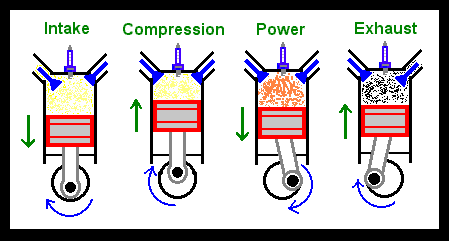 |
| internal combustion engine. Source : http://www.myschoolhouse.com/courses/O/1/143.asp |
Since internal combustion engine has been develop and widely
used, it helps a lot in the transportation sector but it also causes air
pollution towards the environment. In 2010, the number of cars in the world
exceeds 1.015 billion compared to 2009 which is 980 million. Relatively this
growth is also due to that the number of vehicles growth in China as they
contributes to half the growth globally. However U.S. still has the largest
amount of cars in the world which is 239.8 million. China is still 16 times
less than U.S but the car population still exploding. (Tencer, 2011)
The increase of cars also increases the usage of fossil fuel.
As we know petrol is getting lesser day by day and price of petrol is hiking
massively in recent years. Based on the current situation the human society is
very dependent on fossil fuel. For example, in Britain they consume about 7
million tonnes of crude oil just to import food which is a huge amount. (Rhodes, 2013) We still haven’t
added in the consumption of petroleum on public transport and passenger
vehicles.
As fossil fuel is reducing everyday vehicle manufacturer are
trying their best to develop more fuel efficient vehicles. The improvement of
technology allow car manufacturer to develop new engine technology such as
direct fuel injection, direct injection turbo, variable cylinder displacement,
variable valve timing and lift and hybrid vehicles. (Csere, 2010) The introductions of
such new technologies not only to reduce fuel consumption but also to reduce
exhaust emission to protect the environment.
Social Impact of Low Emission Vehicles
As we all know that global warming is
a huge issue and emission standard is getting more stringent. One of the most well-known Emission standards
worldwide is ‘Euro’ Standards. This year 1st September 2014 we are
moving in to Euro 6 level standard. This means that all new cars in the
European Union need to comply with this standard by 1st September
2015. Since Euro emission standard is being accepted internationally new cars
being manufactured around the world will need to start comply with. (European
Automobile Manufacturers Association, 2013)
 |
| Euro emission standard. Source : http://www.acea.be/uploads/news_images/Eurostandards.png |
The
introduction of low emission vehicles will have some negative impact socially
for the time being as there is a shortage of skilled technician to diagnose and
repair such advance vehicles. This problem is much more focus towards the more
advance hybrid vehicles as they have much more complicated electrical on board
circuit and there is very high possibility one might get electrocuted if they
don’t follow proper procedure. It is important that existing companies sent
their staff to attend training so they are prepared for the incoming technology
advance vehicles. This could prevent the current middle aged and older
generation technician or mechanic from losing their job which is also a huge
social problem. (Woodyard, 2012)
Implementation of new technologies
also will give unwanted problems to owners of such technologically advance
cars. These cars may not be brand new as they people could still it from grey
import market such as from Japan or Singapore. While they might look decent on
the outside but internally we can’t assume is the similar as sold by official
dealers. This is because those certain models are specifically design for that
particular market and not suitable in other countries. So if people bought
these cars there are chances that it might breakdown and reliability of new
technology is still an issue. If problems persist car owners will need to spend
more time on visiting workshop which most owners think is a burden. (Biddle, Car
Buyers' Guide: Why some engine issues crop up, 2014)
Low emission vehicles also allows
people to realise how important is low emission vehicles towards the
environment as the cars they buy will produce less tail pipe emission but also
much more fuel efficient compared to older cars. As cars get more fuel
efficient people also pay less for fuel in the long run. One thing we all do
know is that fuel prices will fluctuate so is better to have a fuel efficient
vehicle to keep the running cost down. (Biddle, Make sure your first car
gets you there and back, 2013)
Based on news in The New Zealand
Herald, it is said that New Zealand is planning on a 40% reduction in emission
of greenhouse gases by 2040. Since cars are also one of the contribution of
greenhouse gases so it is important for New Zealand government to convince
people to use low emission vehicles and understand the benefits of it. (Kenworthy,
2013)
References
Bellows, A.
(2006, October 24). The Last Great Steam Car. Retrieved from Damn
Interesting: http://www.damninteresting.com/the-last-great-steam-car/
Biddle, J. (2013,
February 6). Make sure your first car gets you there and back. Retrieved
from The New Zealand Herald:
http://www.nzherald.co.nz/motoring/news/article.cfm?c_id=9&objectid=10863542
Biddle, J. (2014,
March 30). Car Buyers' Guide: Why some engine issues crop up.
Retrieved from The New Zealand Herald: http://www.nzherald.co.nz/motoring/news/article.cfm?c_id=9&objectid=11227432
Csere, C. (2010,
April). The Future of the Internal Combustion Engine. Retrieved from
Car and Driver:
http://www.caranddriver.com/features/the-future-of-the-internal-combustion-engine
European Automobile
Manufacturers Association. (2013, August 8). Vehicle compatibility with
new fuel standards. Retrieved from ACEA:
http://www.acea.be/publications/article/vehicle-compatibility-with-new-fuel-standards
Kenworthy, A.
(2013, October 6). Climate change and how NZ cities are preparing for it.
Retrieved from The New Zealand Herald:
http://www.nzherald.co.nz/climate-change/news/article.cfm?c_id=26&objectid=11135901
Rhodes, P. C.
(2013, July 29). What Happens When the Oil Runs Out? Retrieved from
Oilprice.com: http://oilprice.com/Energy/Crude-Oil/What-Happens-When-the-Oil-Runs-Out.html
Robert E.
Wilhelm, J. (2005, October). Rankine or Otto Cycle, Which is better??
Retrieved from Stanley Motor Carriage:
http://www.stanleymotorcarriage.com/GeneralTechnical/RankineOtto.htm
Tencer, D. (2011,
August 23). Number Of Cars Worldwide Surpasses 1 Billion; Can The World
Handle This Many Wheels? Retrieved from The Huffington Post:
http://www.huffingtonpost.ca/2011/08/23/car-population_n_934291.html
Woodyard, C.
(2012, August 30). Serious shortage of skilled auto mechanics looming.
Retrieved from USA today:
http://usatoday30.usatoday.com/money/autos/story/2012-08-28/shortage-of-auto-mechanics-looms/57414464/1